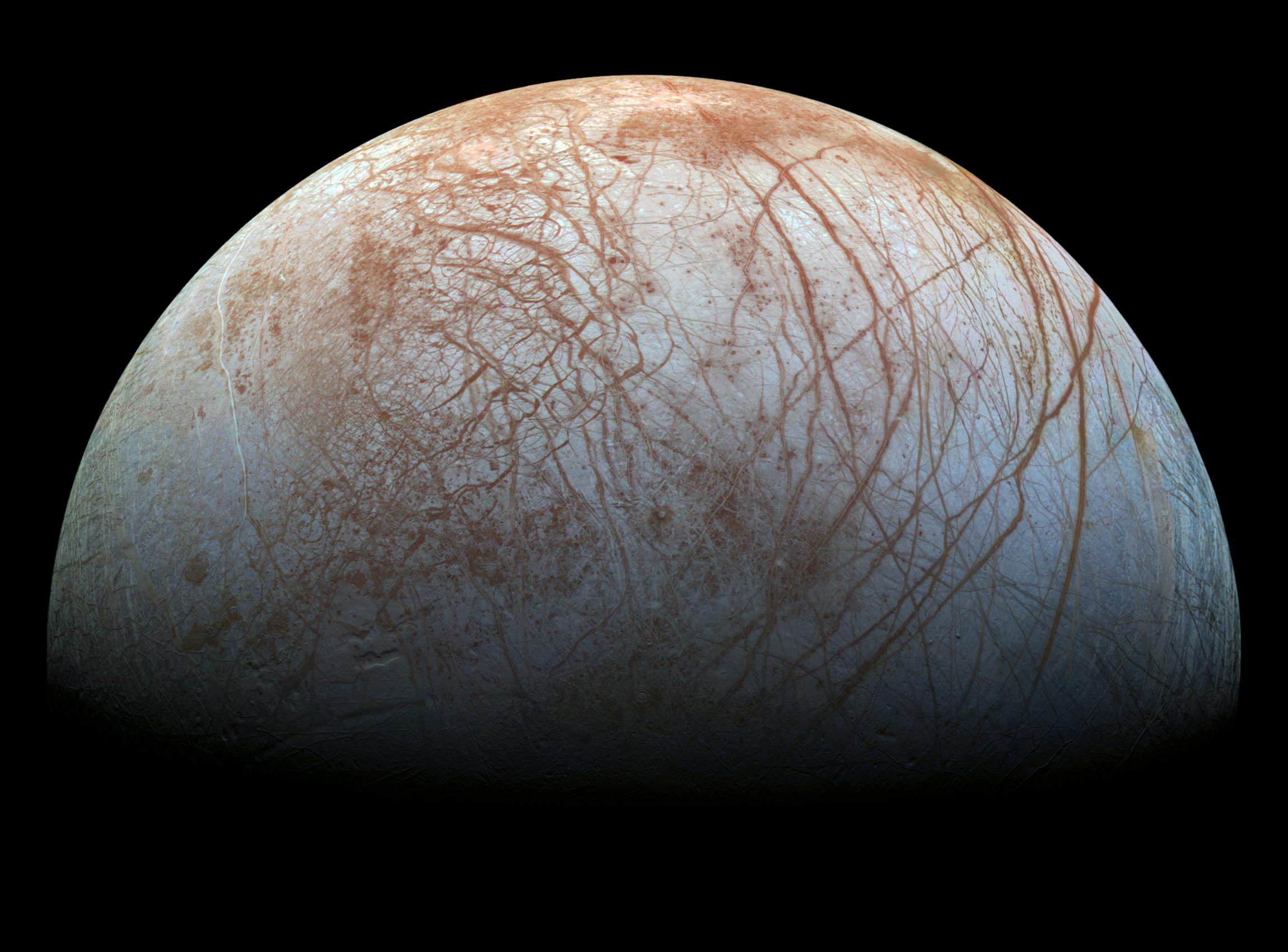
Of all the places in the solar system to look for the ingredients of life, one of the most promising is a moon of Jupiter smaller than our own. Europa's bright surface is a shell of ice, fractured into rust-red cracks — and beneath it, scientists are confident, lies a global ocean of liquid water, kept warm by the gravitational kneading of Jupiter itself. NASA's Europa Clipper is the mission built to investigate it, and right now it is in the middle of one of the longest journeys ever flown.
A slingshot voyage
Europa Clipper launched on October 14, 2024, from Florida aboard a Falcon Heavy rocket. It is the largest spacecraft NASA has ever sent to a planet — with its solar arrays spread, it spans about 100 feet (30 m), the length of a basketball court. Even so, no rocket could throw it straight to Jupiter. Instead, the spacecraft is stealing momentum from planets. On March 1, 2025, it swung past Mars, a flyby that also gave engineers a chance to test two instruments — its heat-mapping camera and its ice-penetrating radar — on a real world. The next appointment is close to home: on December 3, 2026 — just days after this article is published — Clipper will sweep past Earth one final time, stealing a last boost of speed that will carry it all the way out to Jupiter. Arrival is scheduled for April 2030, after a journey of about 1.8 billion miles (2.9 billion km).
An ocean under the ice
The case for Europa's ocean was built by NASA's Galileo spacecraft in the 1990s: magnetic measurements showed something electrically conducting — most plausibly salty water — moving beneath the surface, and images revealed a young, cracked crust like a frozen sea. Current estimates put the ice shell at roughly 10 to 15 miles (15 to 25 km) thick, over an ocean perhaps 40 to 100 miles (60 to 150 km) deep. Added up, Europa may hold about twice as much liquid water as all of Earth's oceans combined — on a moon a quarter of Earth's size. Where there is water, plus the chemical ingredients detected on Europa's surface, plus energy from tidal flexing, there are the basic requirements for life as we know it.
Seeing through ice
Clipper will not land, and it will not orbit Europa directly — Jupiter's fierce radiation belts make that too dangerous. Instead it will orbit Jupiter and dive past Europa 49 times over about four years, some passes skimming just 16 miles (25 km) above the surface. Nine instruments will work the moon over. The REASON radar will ping through the ice shell, measuring its thickness and hunting for pockets of water within it. The EIS camera system will map the surface at high resolution, while spectrometers identify the salts and chemicals staining the cracks. A magnetometer will pin down the ocean's depth and saltiness by how it responds to Jupiter's magnetic field, and a dust analyzer will sample grains knocked off the surface — and could even taste material from the plumes of water vapor that telescopes have occasionally glimpsed erupting from Europa.
Not a life detector — a habitability detective
NASA is careful about one point: Europa Clipper is not designed to detect life, and it will not announce aliens in 2031. Its goal is habitability — confirming the ocean, measuring it, and checking whether Europa has the water, chemistry and energy that life would need. If the answers come back yes, the case for a future lander becomes overwhelming. Either way, by the mid-2030s we will know far more about the most accessible ocean in the solar system — the one that has been waiting, in the dark, a half-billion miles from the Sun.